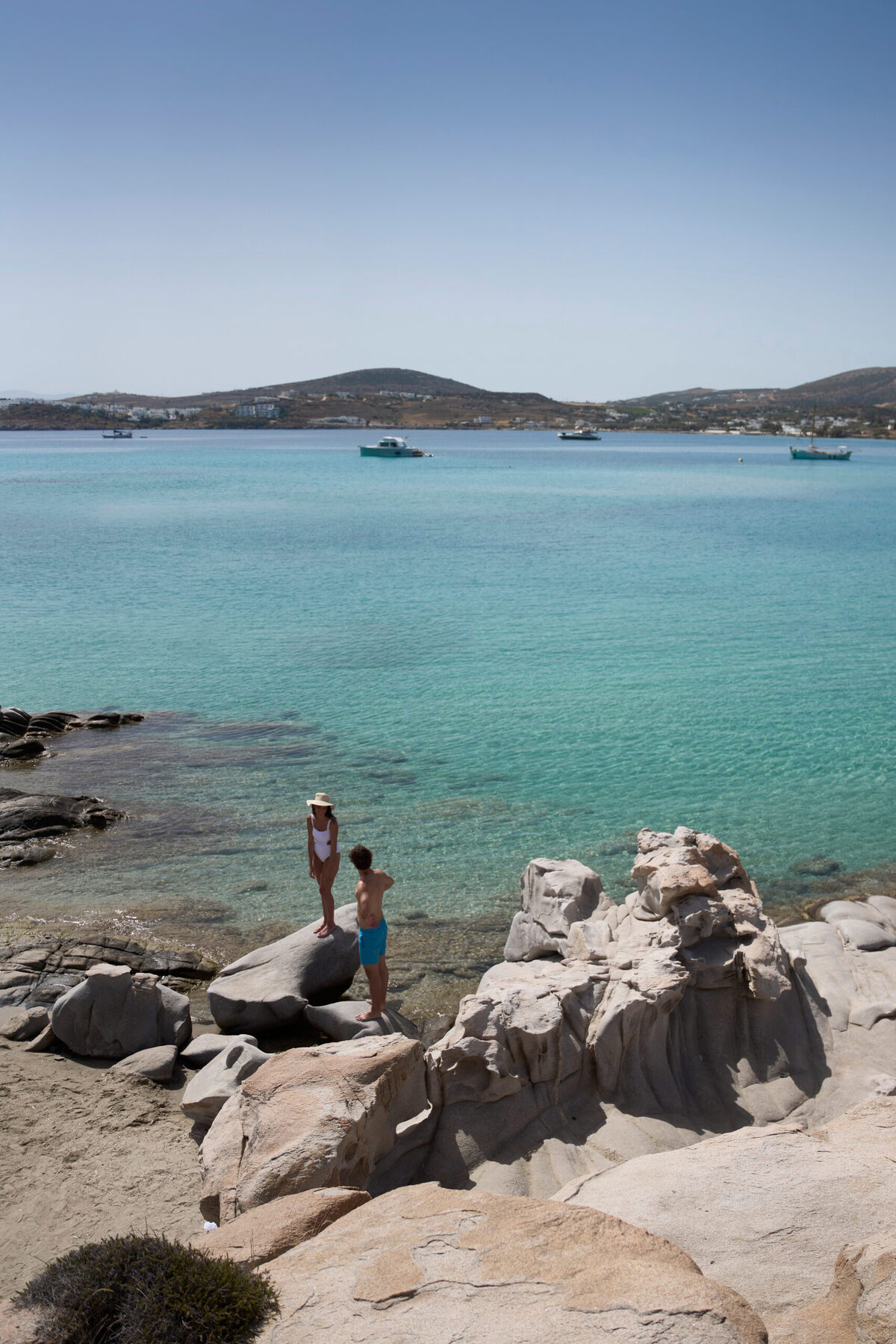
Five Pairings That Make Sense
Which Greek islands belong on the same trip — and how many nights each one is actually worth.
The hardest part of a Greek islands trip isn't picking an island. It's picking the second one — the island that makes the first one better instead of repeating it.
Most trips I'm asked to fix have the same problem. Two islands that do the same thing, or three islands where one is really just a travel day with a hotel attached. The good combinations are the ones where each island is doing a different job: one for the sea, one for the food, one for the view you came for.
These five are the ones I build most often. They're written for seven to ten nights in the Cyclades, and every one of them is shaped around the flights and ferries that actually exist rather than a map. If you're still choosing islands at all, start with the island matrix — fourteen islands placed honestly, with the hotels I'd book on each. This page is the next question: which two or three go together.
Three rules underneath all five
Before the routes, the constraints they're all built on. These are the things that decide whether a combination works, and they have nothing to do with which island is prettiest.
One more thing worth saying plainly: the crossings here are short. Mykonos to Paros is about 45 to 60 minutes. Santorini to Folegandros is about 45. Santorini to Milos and Paros to Santorini are roughly two hours on a high-speed boat. A move between islands is a morning, not a day — as long as it's booked the week the schedules open rather than the week before you go. And when the ferry isn't the right answer — a tight connection, a rough forecast, or simply not wanting to see a port — I arrange private transfers too: a chartered boat between islands, or a helicopter when the day is worth protecting.
A · Folegandros + Santorini
The design-forward one
Folegandros 3 → Santorini 4
For the couple who want the trip nobody else has done.
Folegandros has almost no tourism infrastructure and no airport, and Gundari — low-slung, cut into the cliff on the wild south coast — is the most distinctive hotel in the Cyclades right now. Three nights there is the part of this trip you'll talk about. Then 45 minutes by boat to Santorini for four nights of caldera, and the contrast between the two is the whole point.
This is the only pairing where I'd give Santorini four nights rather than three, because Folegandros is so quiet that you arrive on Santorini still wanting things to do.
B · Milos + Santorini
The swimming one
Milos 4 → Santorini 3
For people whose favourite day is a boat day.
Milos is the swimming island — lunar white rock, volcanic coves, and a coastline that only really makes sense from the water. Four nights gives you a full-day boat charter, the western beaches by ATV, and Sarakiniko early enough to have it to yourself. Then two hours across to Santorini for three nights of caldera and wine.
It's also the most relaxing of the five, and the easiest to do slowly. Milos is where I'd hold the hotel budget down and put the money into a private boat day instead — then spend up on the Santorini nights, where the room is most of the experience.
C · Paros + Santorini
The eating one
Paros 4 → Santorini 3
For a first trip to Greece, and for anyone who plans around dinner.
Paros has the best food in this group and real village life behind it — Naoussa's harbour tavernas are a working port, not a set. Four nights there, then two hours to Santorini for three. It's the easiest pace of the five and the one I recommend most often to people who haven't done the Cyclades before.
Paros is also where two of the strongest hotels in the Cyclades sit — Parilio inland and Cosme on the water — both well under caldera pricing for what you get. If you want an extra night or two of glamour on the front, Mykonos is 45 minutes away and slots in cleanly before Paros.
D · Mykonos + Paros + Santorini
The full arc
Mykonos 2 → Paros 3 → Santorini 3
For a first trip that wants to see the whole range.
Glamour, then village, then caldera — three islands, each doing a completely different job, ending on Santorini as the crescendo. Two nights on Mykonos is exactly right: arrive, one good dinner, one slow beach day, then go. Stretch it to four and the island starts charging you for the privilege.
This is the most movement of the five, but every hop is short — under an hour to Paros, about two to Santorini. It works because you're never unpacking for a single night.
My Mykonos guide → Santorini hotels, ranked → Make this one yours →
E · Mykonos + Sifnos + Santorini
The quiet middle
Mykonos 2 → Sifnos 3 → Santorini 3
For repeat visitors, and anyone who found Mykonos loud last time.
Same bookends as D, with the quietest island in the group in the middle. Sifnos is where Greeks go to eat — hiking trails between hilltop villages, working potters, and tavernas that don't need to advertise. Three nights there resets the trip completely before Santorini.
It's the one I'd pick for a second trip to Greece. The first time, the pull of the famous islands is real and worth honouring; the second time, Sifnos is the answer to why the first trip felt crowded.
F · Naxos + Koufonisia + Amorgos
The undiscovered one — the bonus pairing
Naxos 1 → Koufonisia 3 → Amorgos 3 → Naxos 1
For people who've stopped telling other people where they go.
The Small Cyclades line — a little ferry that threads out of Naxos to islands most itineraries never touch. Koufonisia has the best swimming water in the Cyclades and a one-street town; Amorgos has the monastery bolted to its cliff, real hiking, and evenings that feel like the Greece of thirty years ago. A night on Naxos on each end makes the connections easy and honours the margin rule before your flight.
One honest note, because it matters: there are no luxury hotels on this route — and recommending it anyway is part of the job. Luxury is judgment, not thread count, and out here the right call is the best simple rooms and rentals (I know which ones), a private boat day where it counts, and islands that do the rest — it's why these three sit as hollow rings on the matrix. If you want a five-star bed every night, routes A through E are yours. If you want the trip nobody you know has done, this is it. One footnote for the map-readers: Serifos looks like it belongs in this trip, but it sits on the opposite ferry line entirely — pair it with Sifnos and Milos instead.
Why these islands have no hotel pick → Make this one yours →
How to choose between them
If you want the answer in one line each: A if you want the hotel to be the story. B if you want to be in the water every day. C if it's your first time and you plan around dinner. D if you want to see the whole range in one trip. E if you've done Greece before and want the version without the crowds. And F if you've read this far — the bonus, for the trip where nobody you know has been to any of it.
What I'd push back on: five islands in two weeks, and any route that starts on Santorini. The first is a logistics exercise disguised as a holiday. The second quietly costs you both the best hotels and the best ending. If you're weighing a route you've already sketched, the three mistakes I see most covers the rest.
If one of these read like your trip, that's all I need. Tell me the letter and your dates — it's a five-minute text — and I'll come back with the hotels I'd book on each island and what it costs.
Torn between two? Tell me both and what's pulling you each way, and I'll make the call.
Combinations I'd skip
And the one rule that explains all three.
Every route above is built the same way: each island has a different job. The pairings below fail that test — not because any of these islands is a bad island, but because the second one repeats what the first one already did. When that happens you haven't added a place. You've added a travel day.
Back to back, this is two transfers to swap one expensive crowd for another — same season, same prices, same photographs. It works when something sits between them doing a different job, which is exactly what routes D and E are. Straight from one to the other, you've paid twice for one kind of trip.
Neighbours doing the same thing well — village life, good food, long beaches — and Paros does it better, with two of the strongest hotels in the Cyclades on it. Naxos is a fine island and a poor second one. Spend those three nights somewhere that actually feels different.
Kimolos is lovely and it's twenty minutes from Milos, which is the problem: it's the quiet fishing-harbour version of something Milos already gives you. Go for lunch, come back for dinner. Don't spend a night and a hotel change on it. The one exception since this summer: Espera, the island's first real hotel — if that's the draw, make Kimolos the base and Milos the day trip instead.
One for the sight, one for the silence, one for the water. Three islands that don't compete with each other, all on the same line west — and the clearest illustration of the rule: two islands that contrast beat three that repeat.
If the second island does what the first one already did, cut it and give the nights back to the island you liked. That single edit improves more itineraries than any hotel upgrade I can arrange.
There are three windows I'd book any of these in: May, early June, and September into early October. Late spring gives you everything open and everything green, with the water just warm enough. Autumn gives you a sea that's had all summer to warm up, light that's long and low all afternoon, restaurants open but no longer full, and caldera properties that are impossible in August back within reach.
Early October still works — the sea is swimmable into the second week. But if the dates are entirely yours to choose, go after September 10. The peak-season crowds have gone, everything is still open, and the water is at its warmest all year.
Common questions
How many islands should I do in ten nights?
Two, comfortably. Three if you're willing to give up a morning to each move. Two islands with a long stay on each almost always beats three with a rushed one — the second half of a stay is where a place stops being a sight and starts being somewhere you know.
Which islands have airports?
Santorini and Mykonos are the ones you fly into from outside Greece. Paros and Milos have small airports served mainly from Athens. Folegandros and Sifnos have none — they're reached by ferry, which is a large part of why they're still worth going to.
Should I start or finish on Santorini?
Finish. It's the crescendo, and ending there also opens up the hotels — you're no longer limited to whichever caldera property has space on your arrival date.
Can I take a ferry the same day I fly home?
You can, and I don't book it that way. Ferries cancel for wind with little notice. I leave a night of margin between the last crossing and the flight.
Any of the five routes above, booked end to end — at no cost to you. Hotels, ferries the day the schedules open, private port transfers on both ends, and the restaurant reservations that need booking weeks out rather than the week you arrive.
Start with your dates
Tell me when you're going, who's coming, and which of the five sounds most like your trip. I'll come back with a route, the hotels I'd book on each island, and what it costs.
Start your inquiryNot ready yet? DM me on Instagram — I answer these myself. Or see what planning with me actually looks like.